
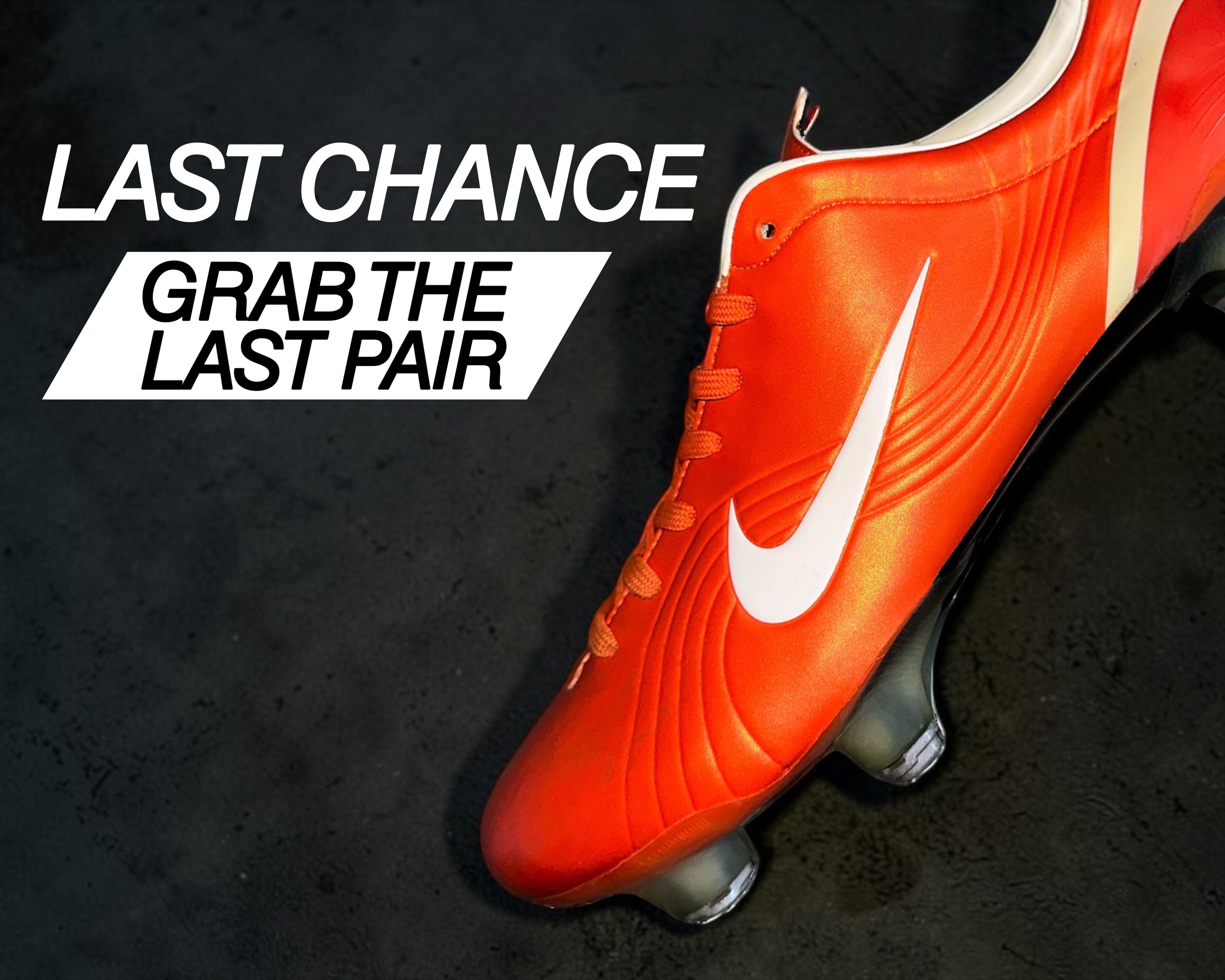


Fake football boots have never looked this convincing. The obvious copies with misspelled logos are mostly gone. Today's replicas come in proper-looking boxes, are sold as "1:1" or "top quality", and are listed right next to genuine pairs. In this guide we walk you through every check we use ourselves, from the listing to the soleplate, so you know exactly what you're buying.
Our main tip before you start: keep official product photos of the exact model and colourway open next to you and compare everything at full zoom. One small flaw can happen on a genuine pair. Several flaws together almost never do.
Why it matters
A fake boot isn't just wasted money. It can get you injured. Replicas copy the look, but not the parts that protect you: the soleplate, the studs and the heel support. The result is blisters, snapped studs, uppers that split after a few sessions and real stress on your ankles and knees.
Because today's fakes look so convincing, one check is never enough. You need to put several small signals together.
Red flags before you buy
- Price: a current elite boot at 70 to 80% off is almost never real. Sales and outlets exist, but not at that level for a brand-new, current-season boot.
- Seller: be careful with new accounts, "all sizes available" for sold-out colourways, and payment without buyer protection.
- Photos: ask for real photos of the size tag, the box label and the soleplate. A listing with stock images only is a red flag.
- Wording: "1:1", "AAA", "mirror" or "top replica" in a listing or its hashtags means fake.
The box
The box is the quickest first check.
- Genuine boxes are made of stiff cardboard, with sharp edges and a lid that sits flush. Fake boxes are often thin, dent easily and have slightly fuzzy print.
- The box design should match the model and season. A current boot in an old-style box, or the other way round, is a warning sign.
- A strong chemical or glue smell when you open it is typical of replicas.

The label
The label on the side of the box is the most useful part of the packaging.
- Find the style code (article number). Nike uses a format like DJ2837-700, adidas a short code like IE1234, Puma a six-digit model number plus a two-digit colour code.
- Search the code online. It must show exactly this model in exactly this colourway. A different boot or no result at all means walk away.
- Check the print. It should be sharp, straight and evenly spaced. Blurry text, wrong fonts or a crooked sticker are classic fake signs.
- Check the size. The size on the label must match the size tag inside the boot.

The size tag
You'll find it on the inside of the tongue or collar. On laceless and sock-collar boots it is often on the inner heel or under the insole.
- The style code must match the box label character for character.
- The production dates (for example 03/24 - 05/24) must make sense for the release. A boot that came out in 2026 can't have been made in 2022.
- The text is sharp and centred. Smudged, overly bold or crooked print is a warning sign.

The insoles
Fakers save money where most buyers never look, so always check inside the boot.
- Genuine insoles have crisp logo prints that don't rub off with your thumb, and foam of even thickness.
- Under a removable insole you should see neat stitching or a clean board, not lumps of glue.
- The lining feels smooth all round, with no hard edges or seams that would rub.

The texture
The upper carries the boot's technology, and that is the hardest part to copy.
- Grip patterns, 3D prints and knit zones are sharp and evenly spread on a genuine boot.
- On fakes the texture is often just printed flat, or the raised parts are blurry, uneven or missing in places.
- A genuine upper is thin and soft where it should be. A replica often feels stiff, plasticky or rubbery all over.
- Logos like the swoosh, the three stripes or the formstrip have an exact shape, angle and position. Even a few millimetres off is a warning, and so are frayed edges or overspray.

The laces
Fakes are often laced or tied in an unusual way that doesn't match how the brand ships the boot. Compare the lacing pattern, the lace length and how the boot sits in the box with official unboxing photos or videos of the same model.
- Tags on the outside: check every tag hanging from the boot or laces against a confirmed genuine pair of the same model. A hang tag in a different style, material or position from what the brand uses for that boot, or a tag on a model that normally ships without one, is a warning sign.
- Extra tags and inserts: genuine pairs often come with extra tags and inserts that replicas leave out.

The heel
The heel is one of the best places to compare a pair, because shape, structure and branding all come together in a small area. Look at the boot from behind and from the side.
- Shape and height: the curve of the heel, the height of the collar and the angle of the heel tab should match the official boot exactly. Fakes often look boxier, higher or lower.
- Inner lining at the heel: in our experience this is one of the clearest tells. On many fakes the padding inside the heel, where your foot slides in, is much thicker and bulkier than on the real boot. Genuine elite boots keep the heel lining thin and close to the foot. Look into the boot from above and compare with official photos or a genuine pair.
- Heel counter: squeeze the heel. On a genuine boot it is firm and keeps its shape. A soft, collapsing heel or a counter that sits crooked is a warning sign.
- Branding and finish: logos and graphics on the heel have the right size, font and position, and the heel meets the soleplate cleanly, with no glue overflow or gaps.

The colours
- Colourways that never existed: many fakes come in colours that were never released for that model. Before anything else, check that the colourway really exists on that exact silhouette, using the brand's website, release databases or the style code. If you can't find it anywhere, it's almost certainly fake.
- Wrong shades: even when the colourway is real, the shades are often off. Green isn't always the same green. Neon can be too dull or too bright, gold can look like yellow paint and gradients can change too abruptly.
- How to check: look at the boot in daylight, not under warm indoor light or a filter, and hold it next to official photos or a genuine pair. Small differences you'd miss on their own become obvious side by side.

The soleplate
Turn the boot over. The soleplate is the hardest part to fake well, and the part that matters most for your safety.
- Material: elite soleplates are thin, light and often partly see-through or carbon-look. Fake plates are usually thicker, heavier and look cheaper.
- Moulding: look for sharp edges, no rough mould seams, no air bubbles, and colours that stay inside their lines.
- Flex: a genuine plate bends at the forefoot and stays stiff under the arch. A fake often bends everywhere or barely at all.
- Stud layout: every model has its own stud pattern. Count the studs and compare their shape (round, bladed, chevron) and position with an official photo of the soleplate.
- Sole text: the tech name, model and type (FG, AG, SG) must be sharp, spelled correctly and match the boot. An "FG" plate on a boot sold as "SG" is a red flag.

Build quality and weight
- Stitching: tight, straight and even. Loose threads or a double line where there should be one are typical of fakes.
- Glue: look where the upper meets the soleplate. Glue overflow, gaps or yellow residue give replicas away.
- Symmetry: put both boots side by side and look from above and from behind. Shape, heel height and logo position should be exact mirror images.
- Weight: elite boots are very light, and brands publish an approximate weight per model. A pair that's noticeably heavier is a warning. A kitchen scale is enough for this check.
Brand details
Nike (Mercurial, Phantom, Tiempo, retro remakes)
- The swoosh follows exactly the curve in the official images: not too thick, not too short.
- On the Mercurial, the speed cage or plate inside is visible and cleanly finished, not a printed imitation.
- Phantom and retro models such as the Hypervenom have raised grip textures. Fakes often turn them into flat prints or uneven bumps.
adidas (F50, Predator, Copa)
- The three stripes are parallel, evenly spaced and at the right angle for that model.
- A laceless collar springs back into shape when you press it. Fake laceless boots are often floppy.
- Predator grip fins are soft rubber in a precise pattern. Replicas make them hard, shiny or misaligned.
Puma (Future, Ultra, King)
- The formstrip has a specific curve and thickness. A stretched or chunky formstrip is a warning.
- The Future's knit collar and compression band feel elastic and snug, not loose.
- The Ultra is extremely light. A heavy Ultra is almost certainly fake.
Quick checklist
One failed check means look closer. Three or more means walk away.
- The box is sturdy, the right design, with no strong chemical smell
- The style code on the label matches this exact boot and colourway online
- The style code and size on the inside tag match the box
- The production dates fit the release
- The insole print is crisp and there is no glue underneath
- The texture is raised where it should be, not printed flat
- The lacing and tags match how the brand ships that model
- The heel shape matches, and the heel lining isn't thick and bulky
- The colourway exists and the shades match official photos in daylight
- The soleplate, stud layout and sole text match the model
A final word
This guide isn't an ad for us. It's here to protect you from scams, lost money and injuries, because plenty of fakes are sold on marketplaces like Vinted, eBay and StockX.
Buy your boots wherever you like. This is our guide to help you stay safe.
And of course, we check every single pair we sell ourselves and would never sell you a fake. That's not a promise, it's who we are.
Follow @euniqueboots on Instagram for more boot guides, releases and classics.